Hi!
My name is Brandon Kelpis and thank you for visiting my website! This website entails my experiences researching dark matter at the Carnegie Institute of Science and working on sounding rocket programs with NASA Wallops.
Cheers!
- Brandon
Dark Matter Annihilation in M31
Carnegie Institute of Science
Mentor: M. Sten Delos
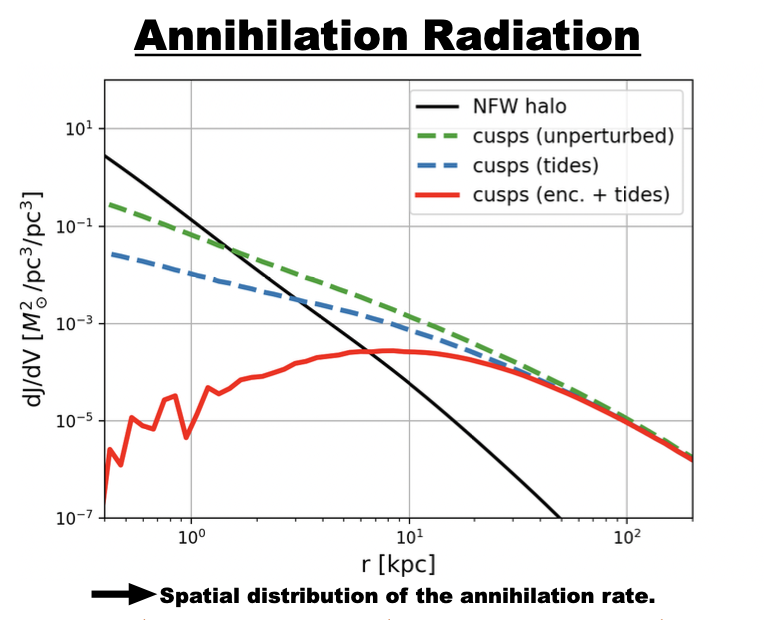
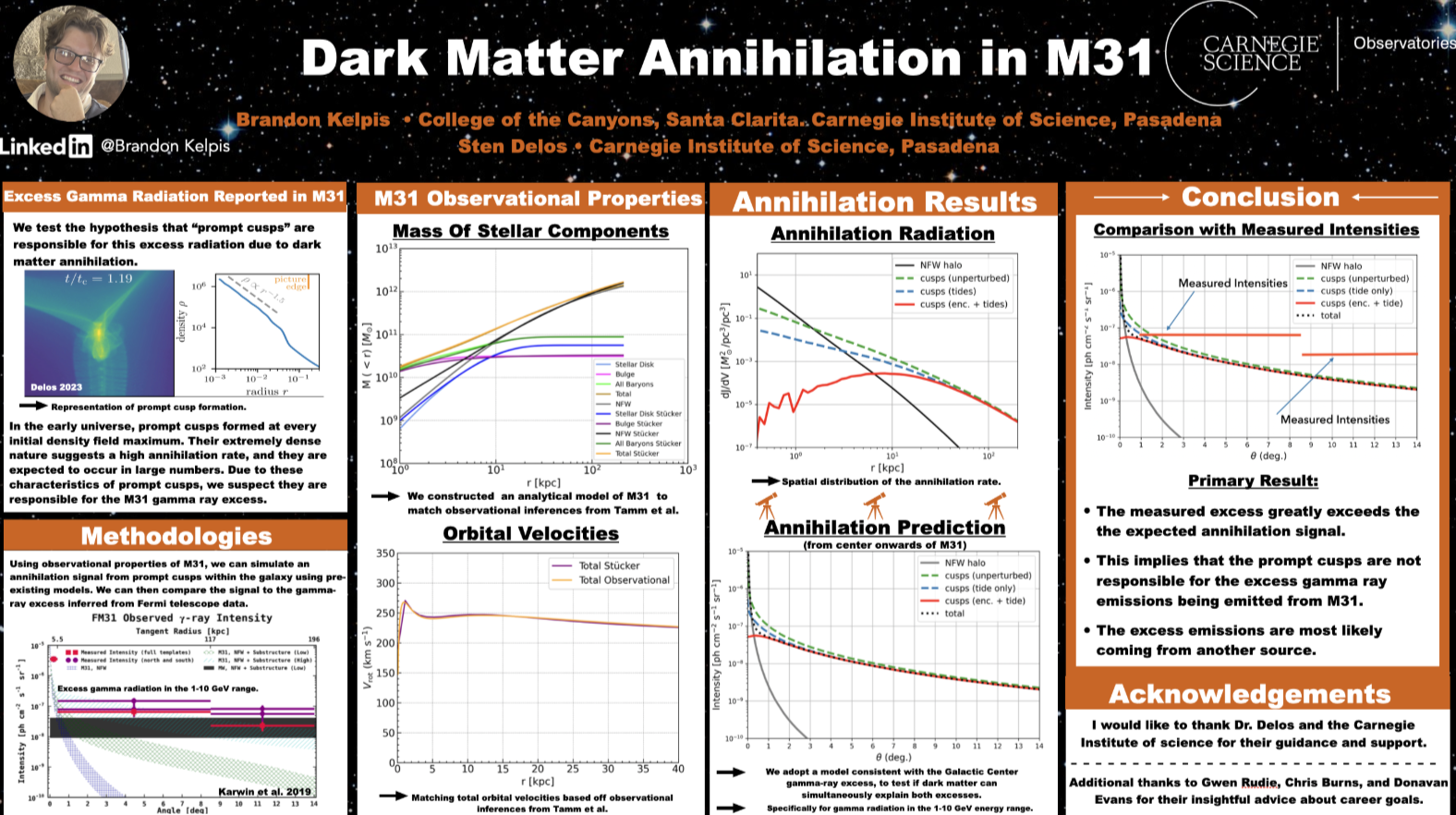
Excess gamma-ray radiation has recently been reported in M31 and has been suggested as coming from dark matter annihilation. However, recent work has shown that dark matter annihilation should be dominated by prompt cusps.
What exactly are prompt cusps? In the early universe, prompt cusps formed at every initial density field maximum. They are expected to possess an extremely dense nature, which also suggests a high annihilation rate. They are also expected to occur in large numbers. Due to these characteristics, we suspect that they are responsible for the M31 gamma-ray excess.
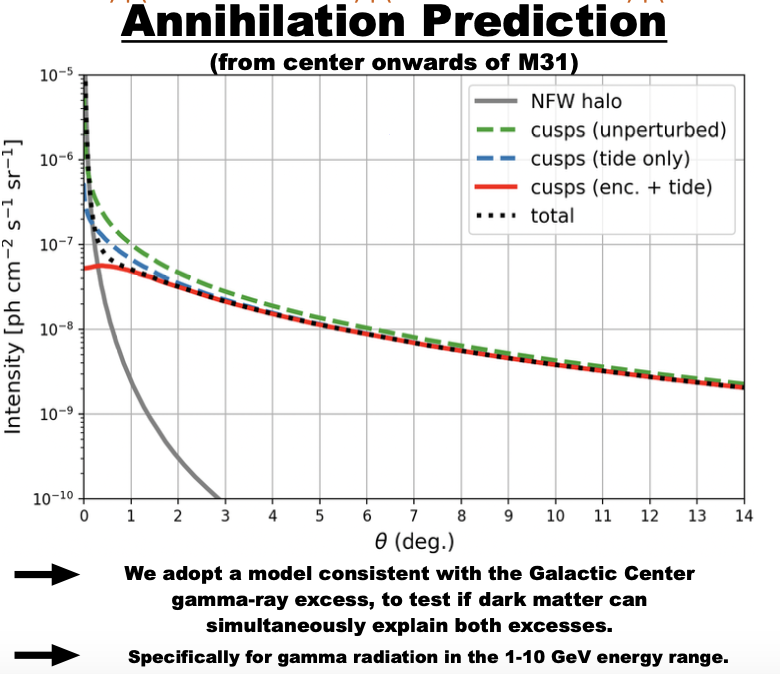
We took a model previously used to analyze annihilation from prompt cusps in the Milky Way halo and then adapted it for M31 based on observed properties.
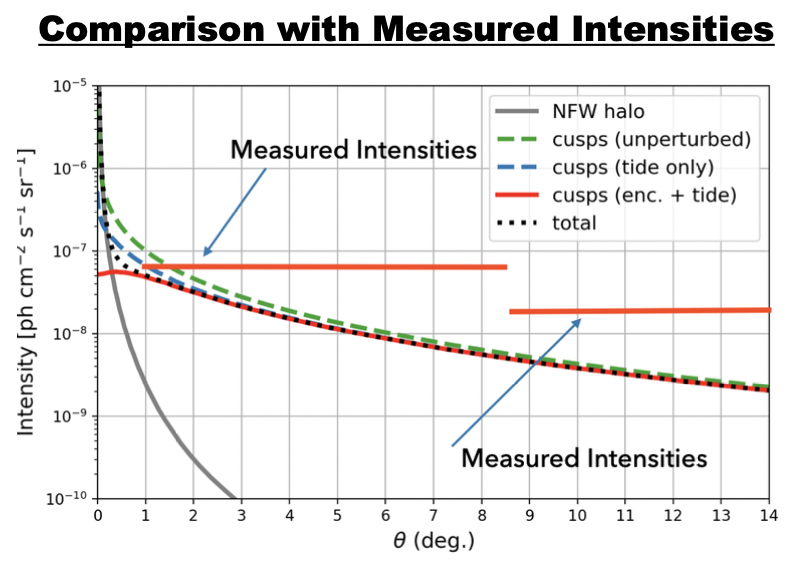
After the adaptation, we can then compare the prediction signal to the measure intensities.
The predicted signal is too weak to account for the gamma-ray excess and is most likely coming from another source.
American Astronomical Society
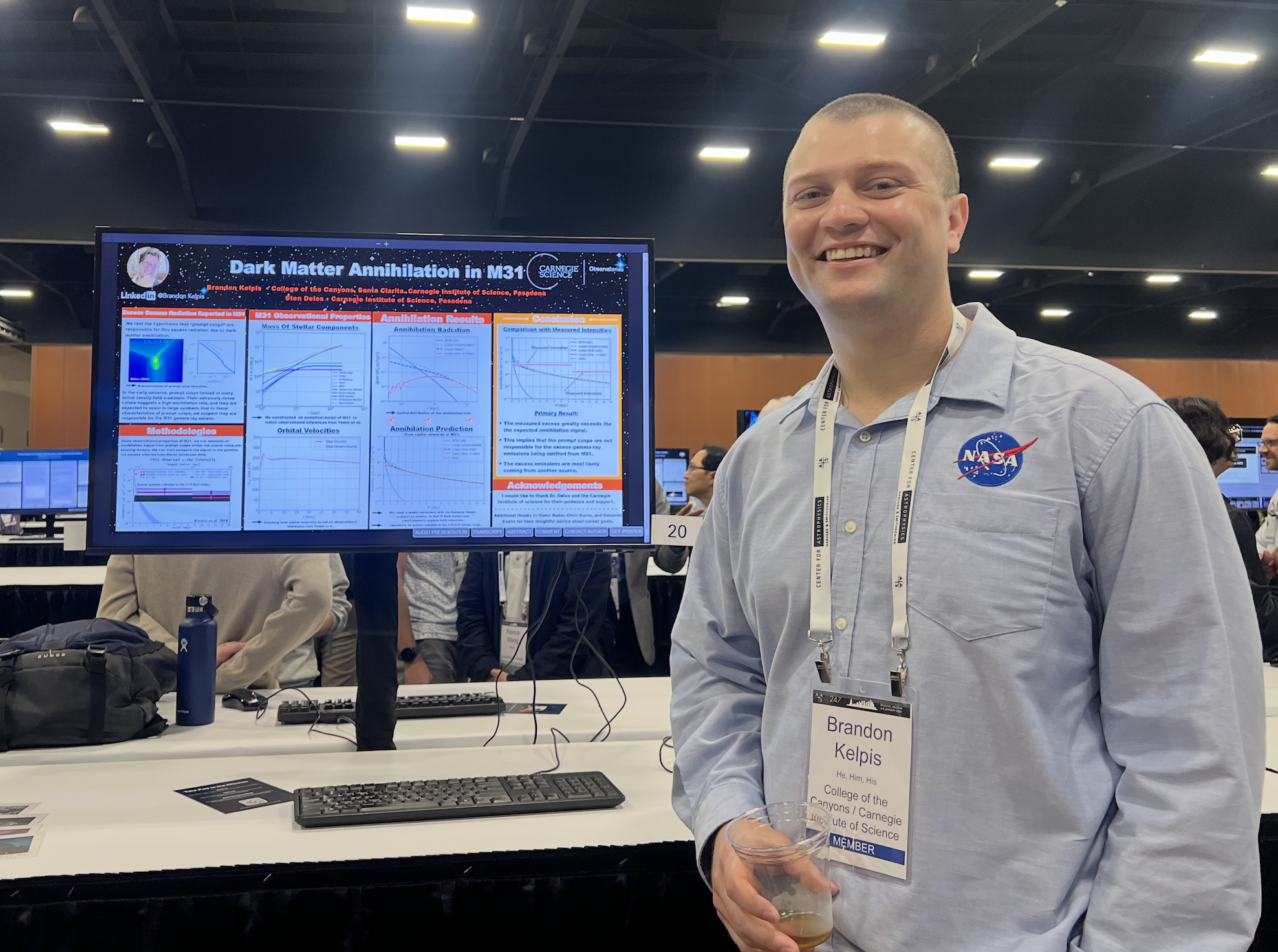
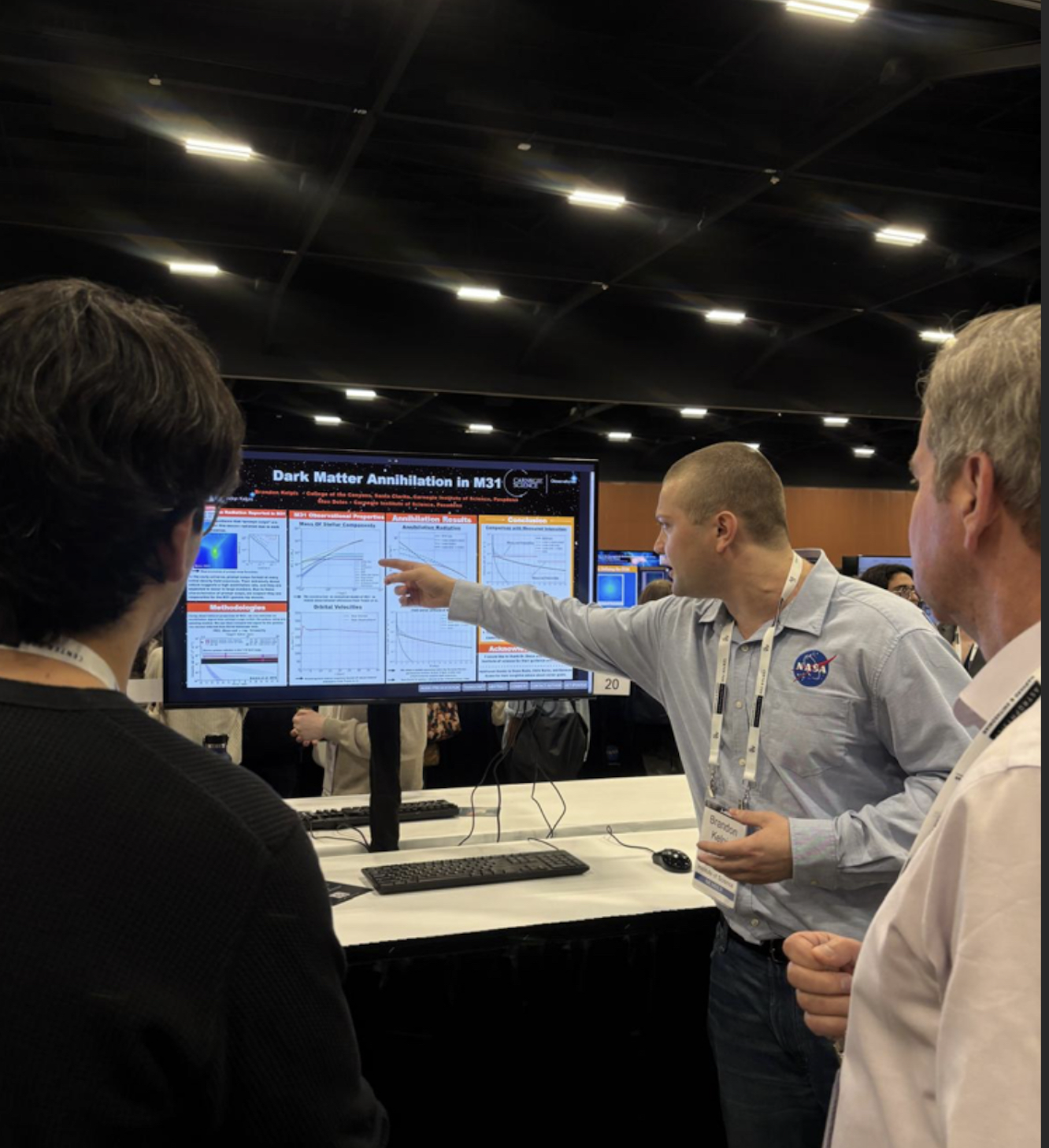
I was blessed with the amazing opportunity to present my research at AAS!
AAS
Year
01/03/2026
NASA Wallops HASP & RockSatX 2024/2025
2024 HASP
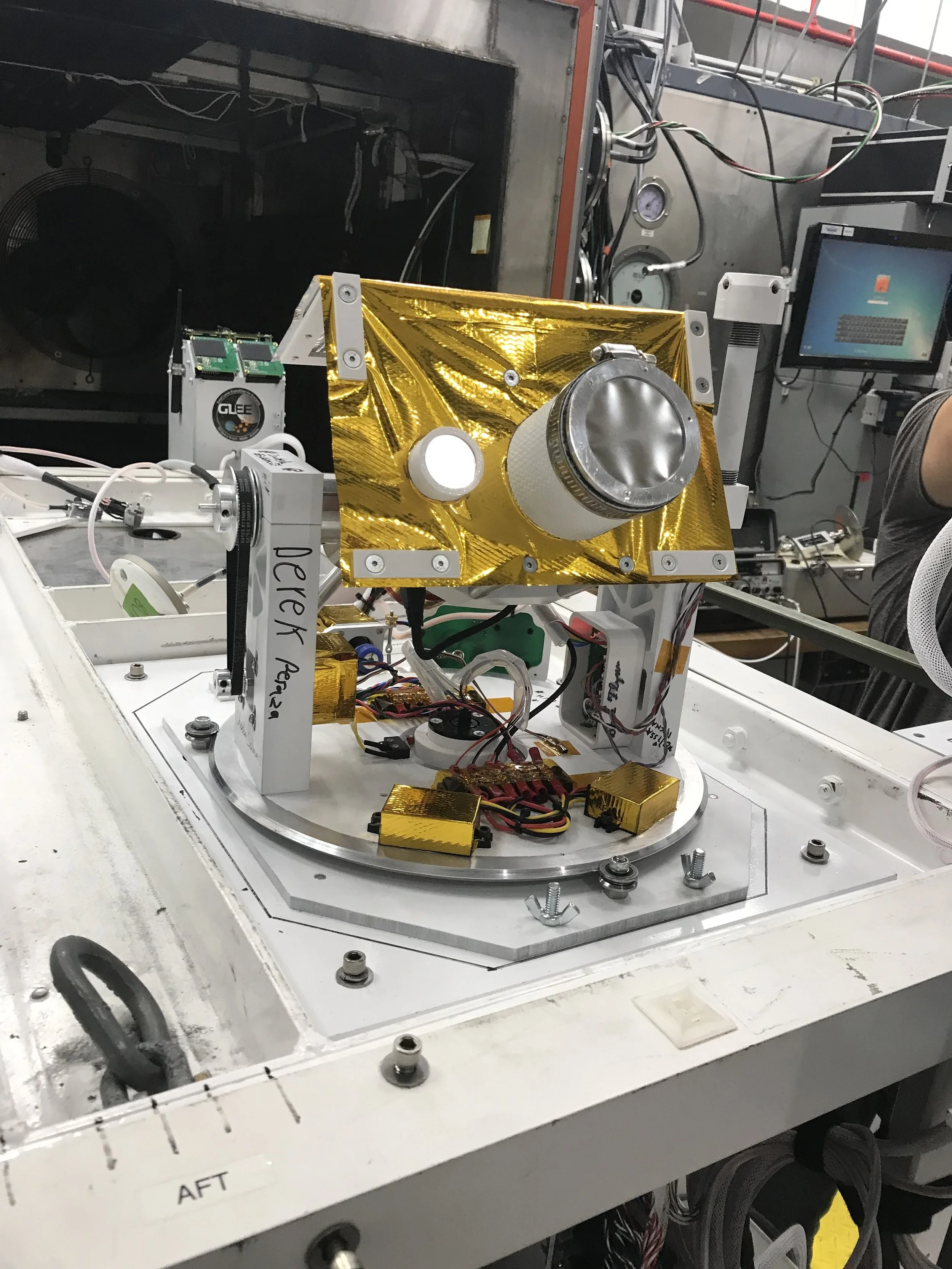
In 2024, I joined a HAAS solar imaging project centered on scanning and photographing the Sun to study features like sunspots and potential solar flare activity. The goal was to capture high-resolution images that could be processed and analyzed later, contributing to a larger effort to better understand solar behavior through direct observation and measurement.
Even though I came onto the project later in its development, I was still able to contribute in a meaningful way. I designed and modeled the upright bearing caps for the system’s mechanical assembly, making sure everything stayed properly aligned, structurally stable, and compatible with the existing components. It required me to quickly get up to speed on an already established design and work closely with the team to meet fabrication deadlines and performance requirements.
2025 RockSatX
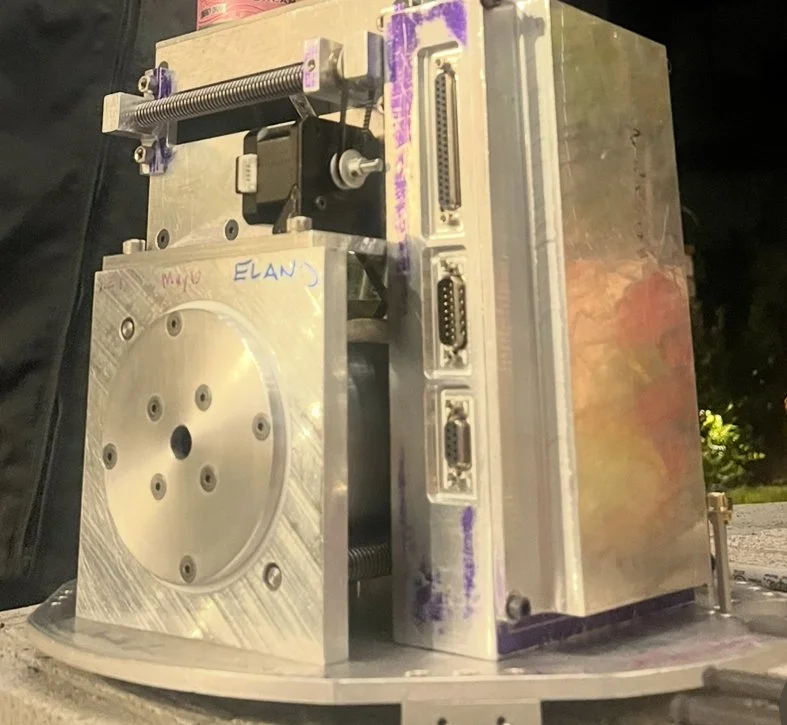
In 2025, I took part in the NASA RockSat-X program, working on a payload built to evaluate structural damage during rocket ascent. Our goal was to use LiDAR to scan the payload in flight, allowing us to assess mechanical stress and possible deformation after launch through detailed post-flight analysis.
Alongside the LiDAR system, the mission also deployed a self-stabilizing gyroscopic capsule designed to maintain its orientation during descent. I served as an Electrical Sub-Lead, where I helped with system-level electrical design, integration, and testing. My responsibilities included assisting with sensor and power integration, and assembly.
2026 RockSatX
In 2026, I am serving as club president and and research lead. Building on work from previous years, we are going mount our LiDAR system inside a pressurized section of the rocket and use it to scan carefully placed objects. This allows us to evaluate structural integrity and detect deformation throughout the flight with a high degree of precision.
The payload also included a distributed temperature sensing system to capture thermal data across multiple stages of ascent and descent. As Research Lead, I developed analytical models to predict temperature and pressure variations over the entire flight profile. These calculations played a direct role in shaping our system design and guiding how we planned to interpret the data under extreme environmental conditions.
During a NASA design review, I presented our thermal and pressure modeling work and received exceptionally strong feedback from NASA engineers, who commented that the depth and rigor of the analysis exceeded expectations for the team.
Images are not yet available, as the payload is currently in the manufacturing phase.